Typical example
Example :
Reflection over the circle of radius \(R\). Suppose \(S\) is the circle \(|z|=R\) and \(z_{1}\) is a point not on \(S\). We find now the reflection of \(z_{1}\) over \(S\).
Our strategy is to map \(S\) to the unit circle, find the reflection and then maps the unit circle back to \(S\).
Start with the map \(T(z)=w=\frac{z}{R}\). Clearly \(T\) maps \(S\) to the unit circle and
\(\hspace{5cm} w_{1}=T(z_{1})=\frac{z_{1}}{R}\).
The reflection of \(w_{1}\) is
\(\hspace{5cm} w_{2}=\frac{1}{w_{1}}=\frac{R}{z_{1}}\).
Mapping back from the unit circle by \(T^{-1}\) we have
\(\hspace{5cm}z_{2}=T^{-1}(w_{2})=Rw_{2}=\frac{R^{2}}{z_{1}}\).
Therefore the reflection of \(z_{1}\) is \(\frac{R^{2}}{z_{1}}\)
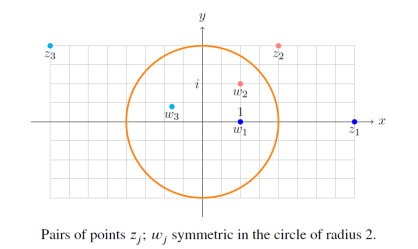
Here are three pairs of points symmetric with respect to the circle of radius \(2\).
\(\hspace{2cm}z_{1} = 4;w_{1}=1,\hspace{1cm}z_{2} = 2+2i;w_{2}=1+i,\hspace{1cm}z_{3} = -4+2i;w_{3}=\frac{-4+2i}{5}\).