Reflection in the unit circle
Using the symmetry preserving feature of fractional linear transformations, we start with a line and transform to the circle. Let \(R\) be the real axis and \(C\) the unit circle. We know that the FLT
\(\hspace{5cm}T(z)=\frac{z-i}{z+i}\)
maps \(R\) to \(C\). We also know that the point \(z\) and \(\overline{z}\) are symmetric with respect to \(R\). Therefore
\(\hspace{3cm}w_{1}=T(z)=\frac{z-i}{z+i}\hspace{1cm}and\hspace{1cm}\)\(w_{2}=T\left( \overline{z}\right) =\frac{\overline{z}-i}{\overline{z}+i}\)
are symmetric with respect to \(C\).
Extra :
Looking at the previous formulas, it is clear that
\(\hspace{5cm}w_{2}=\frac{1}{\overline{w_{1}}}\)
Theorem
The reflection of \(z=x+iy=re^{iθ}\) over the unit circle is
\(\hspace{4cm}\frac{1}{\overline{z}}=\frac{z}{\left\vert z\right\vert ^{2}}=\frac{x+iy}{x^{2}+y^{2}}=\frac{e^{i\theta }}{r}\)
Fundamental :
\(1.\hspace{0,5cm}\) It is possible, but more tedious and less insightful, to arrive at this theorem by direct calculation.
\(2.\hspace{0,5cm}\) If \(z\) is on the unit circle then \(z=\frac{1}{\overline{z}}\). That is, \(z\) is its own reflection over the unit circle as it should be.
\(2.\hspace{0,5cm}\)The center of the circle \(0\) is symmetric to the point at \(∞\).
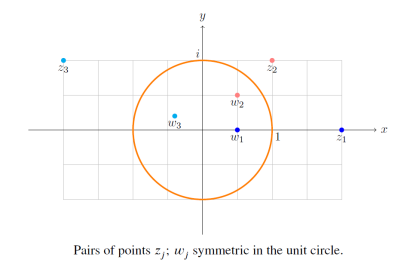
The figure below shows three pairs of points symmetric with respect to the unit circle:
\(z_{1}=2;w_{1}=\frac{1}{2},\hspace{1cm}z_{2}=1+i;w_{2}=\frac{1+i}{2},\hspace {1cm}z_{3}=-2+i;w_{3}=\frac{-2+i}{5}\)
Proposition
For a circle \(S\) with center \(c\) the pair \(c,∞\) is symmetric with respect to the circle.
Proof : This is an immediate consequence of the formula of the reflection of a point over a circle.
For example, the reflection of \(z\) over the unit circle is \(\frac{1}{z}\). So, the reflection of \(0\) is infinity.