Reflection and symmetry in a line
Fundamental :
Let \(S\) be a line and let \( z_{1}\) be a point not on \(S\). The reflection of \(z_{1}\) over \(S\) is the point \(z_{2}\) so that \(S\) is the perpendicular bisector to the line segment \(\overline{z_{1}z_{2}}\). Since there is exactly one such point \(z_{2}\), the reflection of a point over a line is unique.
Definition :
If \(z_{2}\) is the reflection of \(z_{1}\) over \(S\), we say that \(z_{1}\) and \(z_{2}\) are symmetric with respect to the line \(S\).
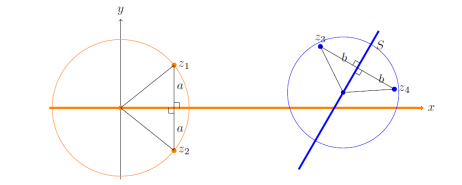
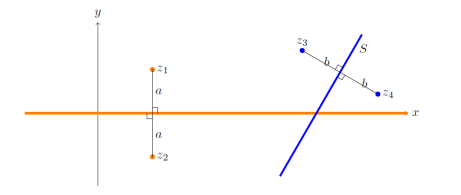
In the figure below the point \(z_{1}\) and \(z_{2}\) are symmetric with respect to the \(x-\)axis and the points \(z_{3}\) and \(z_{4}\) are symmetric with respect to the line \(S\).
Proposition
If \(z_{1}\) and \(z_{2}\) are symmetric with respect to the line \(S\), then any circle through \(z_{1}\) and \(z_{2}\) intersects \(S\) orthogonally.
Proof
Let \(C\) be a circle containing \(z_{1}\) and \(z_{2}\) . Since \(S\) is perpendicular bisector of a chord of \(C\) which is \(\overline{z_{1}z_{2}}\), then the center of \(C\) lies in \(S\). Therefore \(S\) is a radial line, i.e. it intersects \(C\) orthogonally.