Exercise 3
Exercise 3
Show that if a circle and a line don't intersect then there is a pair of points \(z_{1},z_{2}\) that is symmetric both with respect to the line and the circle.
Solution
By shifting, scaling and rotating we can find a fractional linear transformation \(T\) that maps the circle and line to the following configuration:
The circle is mapped to the unit circle and the line to the vertical line \(x=a>1\).
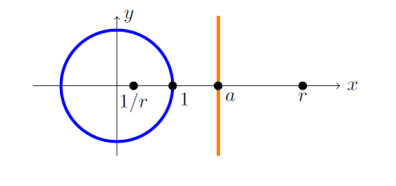
For any real \(r\), \(w_{1}=r\) and \(w_{2}=\frac{1}{r}\) are symmetric with respect to the unit circle. We can choose a specific \(r\) so that \(r\) and \(\frac{1}{r}\) are equidistant from \(a\), i.e. also symmetric with respect to the line \(x=a.\) It is clear geometrically that this can be done. Algebraically we solve the equation
\(\hspace{0,5cm} a=\frac{r+\frac{1}{r}}{2}=\frac{\frac{r^2+1}{r}}{2}\Rightarrow r^{2}-2ar+1=0\Rightarrow r=a+\sqrt{a^{2}-1}\Rightarrow \frac{1}{r}=a-\sqrt{a^{2}-1}\)
Thus \(z_{1}=T^{-1}\left( a+\sqrt{a^{2}-1}\right)\) and \(z_{2}=T^{-1}\left( a-\sqrt{a^{2}-1}\right)\) are the required points.