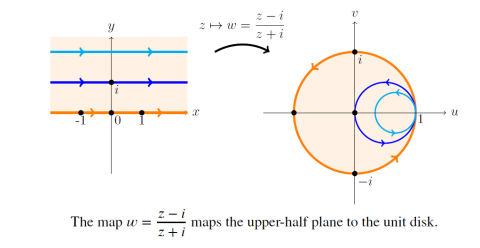
Exercise 1
Exercise 1
Let
\(\hspace{5cm}T\left( z\right) =\frac{z-i}{z+i}.\)
Prove that \(T\) maps the \(x-\)axis to the unit circle and the upper half-plane to the unit disk.
Solution
First take \(x\) real, then
\(\hspace{5cm}\left\vert T\left( x\right) \right\vert =\frac{\left\vert x-i\right\vert }{\left\vert x+i\right\vert }=\frac{\sqrt{x^{2}+1}}{\sqrt{x^{2}+1}}=1.\)
So, \(T\) maps the \(x-\)axis to the unit circle.
Next take \(z=x+iy\) with \(y>0\), i.e. \(z\) in the upper half-plane. Clearly
\(\hspace{6cm}|y+1|>|y-1|,\)
so
\(\hspace{3cm}|z+i|=|x+i(y+1)|>|x+i(y-1)|=|z-i|,\)
implying that
\(\hspace{6cm}\left\vert T\left( z\right) \right\vert =\frac{\left\vert z-i\right\vert }{\left\vert z+i\right\vert }<1.\)
So, \(T\) maps the upper half-plane to the unit disk.
We will use this map frequently, so for the record we note that
\(\hspace{2cm}T(i)=0,\hspace{1cm}T(∞)=1,\hspace{1cm}T(-1)=i,\hspace{1cm}T(0)=-1,\hspace{1cm}T(1)=-i\)
These computations show that the real axis is mapped counterclockwise around the unit circle starting at \(1\) and coming back to \(1\).