Preliminaries
Fundamental : Informal definition
Conformal maps are functions on \(\mathbb{C}\) that preserve the angles between curves.
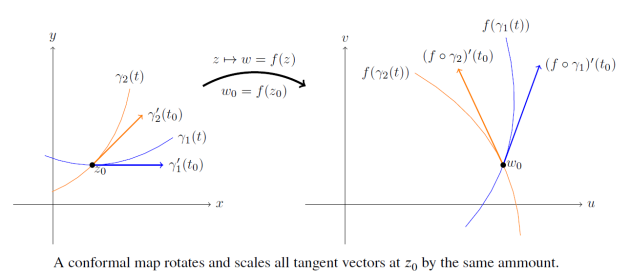
More precisely : Suppose \(f(z)\) is differentiable at \(z_{0}\) and \(γ(t)\) is a smooth curve through \(z_{0}\). To be concrete, let's suppose \(γ(t_{0})=z_{0}.\) The function maps the point \(z_{0}\) to \(w_{0}=f(z_{0})\) and the curve \(γ\) to \(f(γ(t)).\)
Under this map, the tangent vector \( γ′(t_{0})\) at \(z_{0}\) is mapped to tangent vector
\(\hspace{5cm}γ′(t_{0})=(f∘γ)′(t_{0})\)
at \(w_{0}\).
Extra :
With these notations we have the following definition.
Definition :
The function \(f(z)\) is conformal at \(z_{0}\) if there is an angle \(φ\) and a scalar \(a>0\) such that for any smooth curve \(γ(t)\) through \(z_{0}\) the map \(f\) rotates the tangent vector at \(z_{0}\) by \(φ\) and scalar it by \(a\). That is, for any \(γ\), the tangent vector \((f∘γ)′(t_{0})\) is found by rotating \(γ′(t_{0})\) by \(φ\) and scaling it by \(a\).
If \(f(z)\) is defined on a region \(A\), we say that it is a conformal map on \(A\) if it is conformal at each point \(z\) in\( A\).
Note :
The scale factor \(a\) and rotation angle \(φ\) depend on the point \(z\), but not on any of the curves through \(z\).
Example :
The figure below shows a conformal map \(f(z)\) mapping two curves through \(z_{0}\) to two curves through \(w_{0}=f(z_{0})\). The tangent vectors to each of the original curves are both rotated and scaled by the same amount.
Remark 1
Conformality is a local phenomenon. At a different point \(z_{1}\) the rotation angle and scale factor might be different.
Remark 2
Since rotations preserve the angles between vectors, a key property of conformal maps is that they preserve the angles between curves.